
The Office for National Statistics (ONS) has updated its life expectancy projections.
Life expectancy calculations matter, and not just to answer that perennial question. Any long-term economic projections, such as the scary ones that the Office for Budget Responsibility (OBR) produces each year, have life expectancy as a key component. However, life expectancy is only one of the demographic factors used, and others, such as the fertility rate (about 1.4 children per woman currently) and the net migration rate, are less easy to estimate in the longer term.
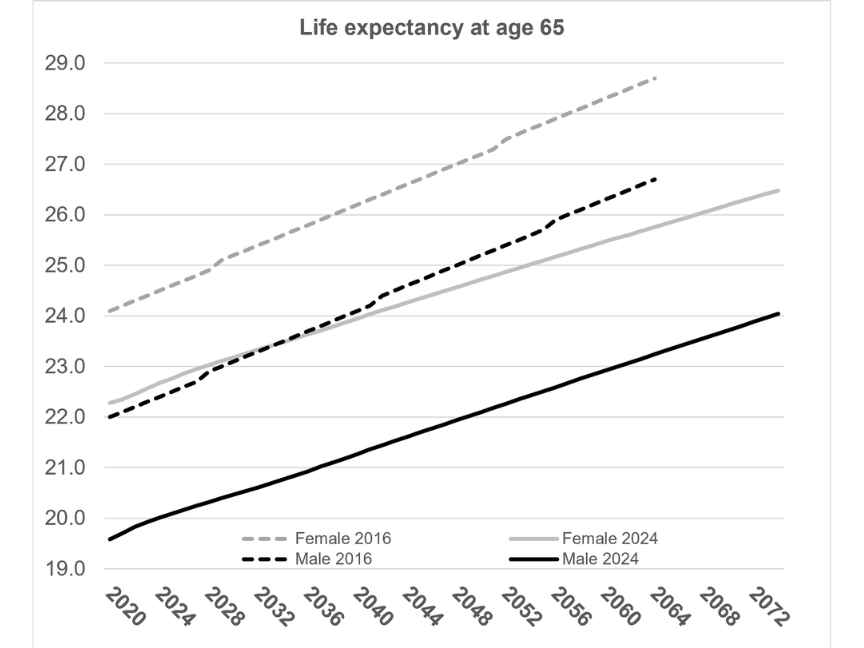
The ONS recently revised projections for UK life expectancy, using past and projected mortality data from its 2024-based national population projections. Normally, the ONS issues updates every other year and the latest are little different from their immediate 2022 predecessors. However, an examination of the 2014-basis projections reveals a surprising change. It is well illustrated in the graph below, which shows projected life expectancy for men and women who reached or will reach the age of 65 from 2020 onwards.
Life expectancy on the 2024 basis for a woman aged 65 in 2026 has fallen by 1.8 years compared with the 2014 basis and by 2.4 years for her male counterpart. Make no mistake, life expectancy is still rising over time – hence the upward sloping lines – but the ONS has significantly reduced its estimate of the pace of improvement. That could have an impact on the government’s imminent decision about when to increase the State pension age to 68; it is currently in the process of moving to 67 by April 2028.
If you want to see the ONS projection for your age, then the ONS has a dedicated calculator. Don’t just look at the headline number the calculator produces but scroll down the page to see your life expectancy graph and chances of living to 90 or 100. At ages above 50, men have at least a one-in-three chance of reaching age 90, while for women the odds are nearly even. The question then should be: ‘Is your pension going to last that long?’
Get in touch with us by calling 0114 266 4432 or email info@smh.group for more information.



Comments are closed.